

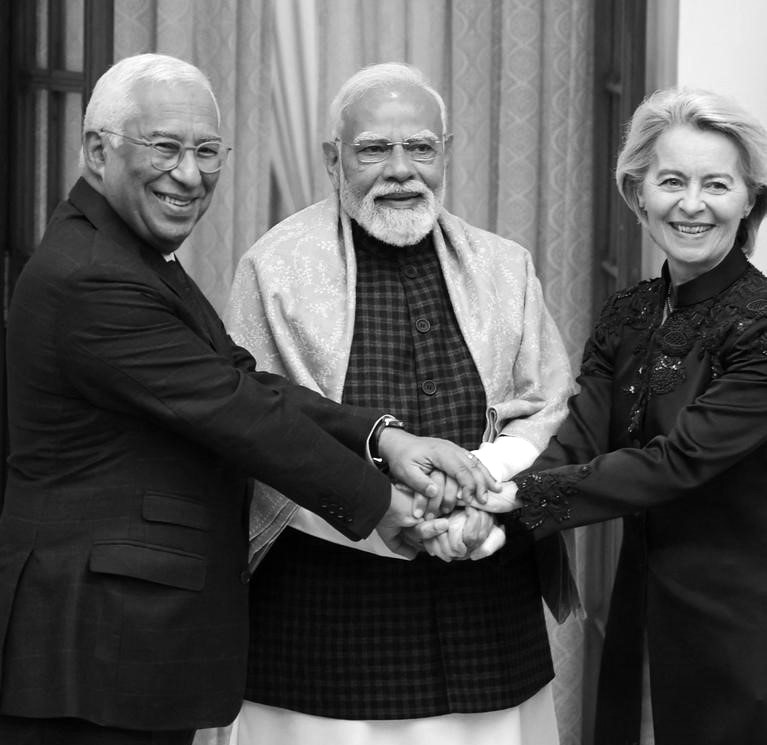
It took eighteen years of skepticism, abandoned rounds, and geopolitical posturing, but the “impossible” has finally happened. On January 27, 2026, Prime Minister Narendra Modi and European Commission President Ursula von der Leyen stood side-by-side in New Delhi to announce the conclusion of the India–European Union Free Trade Agreement (FTA).
Dubbed the “Mother of All Deals,” this pact does more than just lower the price of a bottle of Bordeaux or a luxury sedan. It creates a seamless economic corridor for two billion people, encompassing 25% of the world’s GDP. For the Indian business community, this is the most significant structural shift since the 1991 liberalization. But as with any marriage of giants, the fine print contains both a roadmap to unprecedented wealth and a series of high-stakes trade-offs.
The New Economic Architecture: What Just Changed?
For nearly two decades, the stumbling blocks were predictable: India’s high tariffs on cars and alcohol versus Europe’s stringent demands on labor and environmental standards. The 2026 agreement has finally broken that deadlock through a “calibrated opening.”
The Tariff Revolution
India has agreed to slash its legendary 110% tariff on European motor vehicles down to 10% (under a 250,000-unit annual quota). Conversely, the EU is scrapping tariffs on over 90% of Indian goods immediately, moving toward 99.5% coverage within a decade. For the Indian exporter, the “Fortress Europe” walls have effectively been dismantled.
Capitalizing on the Opportunity: The “Winner’s Circle”
If you are an Indian entrepreneur, the opportunities are no longer theoretical. The FTA provides a massive competitive edge in several key domains:
1. The Labor-Intensive Renaissance
The biggest winners are the sectors that employ millions: textiles, leather, gems, and jewelry. Previously, Indian apparel faced a 12% duty in the EU, while competitors like Bangladesh enjoyed duty-free access. That handicap is gone.
• The Play: Indian manufacturers can now integrate directly into European high-street supply chains without the pricing disadvantage that has dogged them for years.
2. The Services and “Mobility” Jackpot
Perhaps the most surprising “win” for India is the Mobility Pact. The EU has committed to “uncapped mobility” for Indian students and simplified visas for skilled professionals.
• The Play: For India’s $250 billion IT sector, this isn’t just about outsourcing; it’s about “insourcing” presence. Indian firms can now deploy consultants across the 27-member bloc with far less red tape, positioning India as the backend—and increasingly the frontend—of Europe’s digital transition.
3. The Green Energy Bridge
With the EU aiming for carbon neutrality and India scaling its solar and green hydrogen capacity at breakneck speed, the FTA includes a €500 million support package for India’s green transition.
• The Play: European capital and Deep Tech IP are looking for a “sandbox” for scale. Indian businesses in EV components, battery storage, and green hydrogen are now the preferred partners for European giants looking to de-risk from China.
The Trade-Offs: The Price of Admission
No deal of this magnitude comes without a “cost of doing business.” For Indian industry, the challenges are primarily regulatory rather than fiscal.
1. The “Regulatory Wall” (CBAM and EUDR)
While tariffs are falling, non-tariff barriers are rising. The EU’s Carbon Border Adjustment Mechanism (CBAM) means that Indian steel and aluminum exports will face a “carbon tax” if they aren’t produced using green energy.
• The Risk: Small and Medium Enterprises (SMEs) that lack the capital to green their supply chains may find themselves “taxed out” of the market despite the zero-tariff regime.
2. The Intellectual Property (IP) Tightrope
The EU has secured “ambitious” IP commitments, bringing Indian laws closer to European standards.
• The Risk: This could lead to longer patent protections for European pharmaceuticals, potentially impacting India’s “Pharmacy of the World” status by delaying cheaper generics.
3. The Agricultural Sensitive Zone
To protect the “soul” of both regions, certain items remain off the table. India has successfully shielded its dairy and poultry sectors. However, India has opened its doors to European wines, spirits, and processed foods. Local Indian winemakers and gourmet food producers now face a direct fight for the domestic middle-class wallet.
A Columnist’s Take: The “Beginning” of the Beginning
When Ursula von der Leyen remarked that this is “just the beginning,” she wasn’t using a cliché. This FTA is a strategic pivot. In a world where the US–China rivalry is fragmenting global trade, India and Europe have realized they are each other’s best hedge.
For the Indian business person, the era of cost-arbitrage is ending. You can no longer win simply by being cheaper. To capitalize on this pact, Indian firms must move up the value chain. You must become compliant (ESG), innovative (IP-driven), and integrated into the European Single Market.
The gates are open. The 2026 trade pact has handed Indian business the keys to the world’s most sophisticated consumer market. The question is no longer whether we can compete, but whether we are ready to lead.